
Who’s Your Sickles?
Organizations become fragile when leaders stop acting like teammates and start acting like candidates.

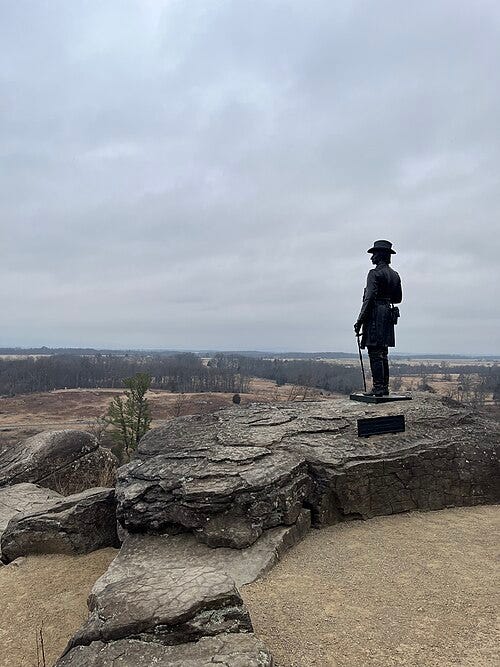
We often think organizational failure comes from external competition, economic uncertainty, or changing conditions. Sometimes it does. But history repeatedly reminds us that some of the greatest dangers come from within—and that organizations are often saved by leaders willing to put the mission ahead of themselves. In early July 1863 during the second day of the Battle of Gettysburg, the Civil War’s bloodiest battle, Union officer Major General Daniel Sickles made a decision that nearly unraveled the Union Army’s defensive line at the worst possible moment. Without informing his commanding general, George G. Meade, Sickles advanced his corps well forward of its assigned position, exposing the Union flank and leaving critical terrain known as Little Round Top undefended. Only the alert actions of Meade’s chief engineer, Gouverneur K. Warren, and the rapid movement of Union troops prevented what could have become a catastrophic defeat.
The details of Gettysburg matter less than the leadership lesson. Most organizations have a “Sickles”—someone compelled to operate above the team, who’s more focused on personal standing than collective success. Individuals like this often possess talent, charisma, and influence, but they can also create enormous organizational vulnerability because they cannot be fully trusted. They freelance decisions, build political alliances, withhold information, and quietly place personal ambition ahead of shared purpose.
Sickles, a well-connected political general, was closely aligned with Meade’s predecessor, Joseph Hooker, who was fired by President Lincoln. After Gettysburg, Sickles spent years attempting to damage Meade’s reputation to protect his own. The battlefield may change over time, but human nature rarely does.
In my book Large and In Charge No More—A Journey to Vulnerable Leadership, I argue that vulnerability is grounded in empathy and self-awareness. Vulnerable leaders understand that leadership is not about drawing attention to themselves; no, it’s about strengthening the team around them. They communicate openly, align with organizational intent, and recognize that trust is the foundation upon which successful teams are built. Sickles demonstrated the opposite approach. His actions introduced confusion, exposed others to unnecessary risk, and forced fellow leaders to compensate for problems he himself created. Organizations become fragile when leaders stop acting like teammates and start acting like candidates.
What makes the Gettysburg story particularly powerful is that it also highlights the importance of leaders like Warren. Upon recognizing the danger, Warren acted immediately—not for personal credit, but because the mission demanded it. He communicated, collaborated, and focused entirely on protecting the larger organization. Vulnerable leadership often looks like that: quiet professionalism, humility, accountability, and a willingness to put collective success ahead of personal recognition. In healthy organizations, those qualities build trust vertically and horizontally. In unhealthy organizations, leaders spend more time managing personalities and agendas than focusing on the mission itself.
The real question for leaders today is not simply, “Who’s your Sickles?” but also, “How might I be acting like one?” Every organization has its own version of Little Round Top—a critical responsibility, relationship, or weakness that can become exposed when ego overrides teamwork. The strongest leaders are not those who constantly seek the spotlight. They’re the ones who understand that leadership is ultimately an act of stewardship, not self-promotion.
History remembers Gettysburg as a Union victory, but it also reminds us how dangerously close organizations can come to failure when trust, communication, and humility break down at the top.
What an excellent analogy, Mike. You're right that almost every leader suffer some Sickles in their midst, and it's important not to play that role. The worst scenario is when the Sickles rises to the top, which is very often the case. Then all that narcissism and its accompanying insecurity infects the whole organization.